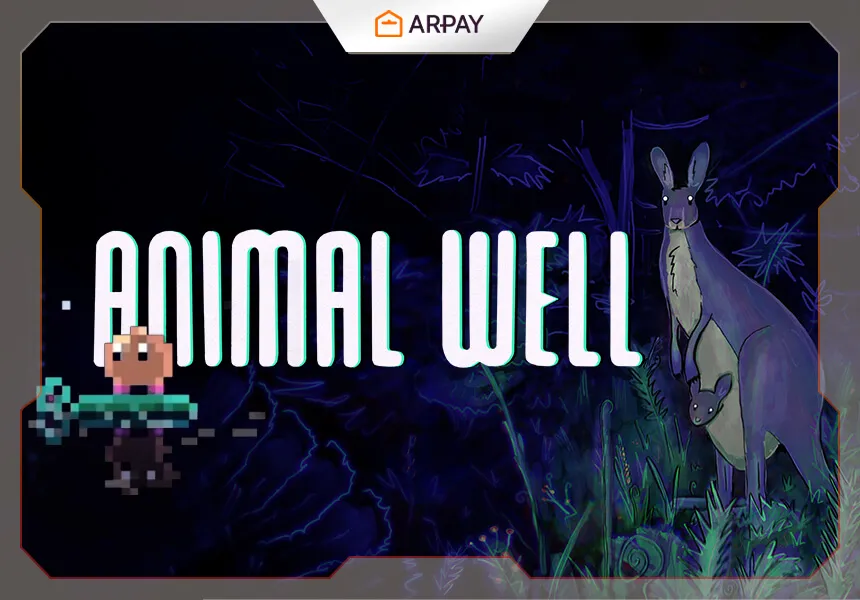
Where Would You Play Animal Well
You can play Animal Well on several platforms:- PC via Steam
- PlayStation 5 via the PlayStation Store
- Nintendo Switch
- Xbox Series X|S and Xbox Cloud Gaming (Beta)3
Animal Well Gameplay Mechanics and Features
Gameplay Mechanics
- Non-Linear Exploration: Free world exploration allows players to discover secrets and solve puzzles organically instead of on a predetermined path.
- Puzzle Solving: The game is filled with intricate puzzles that require creative thinking and keen observation to solve. These puzzles vary in difficulty, providing a consistent challenge throughout the game.
- Hidden Secrets: The world of Animal Well is replete with secrets and items that players can find by detailed exploration and by solving environmental puzzles.
- Distinctive Interactions: It provides the players with novel and innovative environments that they are exposed to and items discovered to either open new areas or resolve a puzzle.
- Lighting and Shadows: The dynamic usage of lighting and shadows is quite impressive, playing an indispensable role in solving puzzles or finding your way through the environment. Cleverly utilized the usage of light and shadows to illuminate hidden paths and secret locations.
Key Features
[caption id="attachment_29093" align="alignnone" width="860"]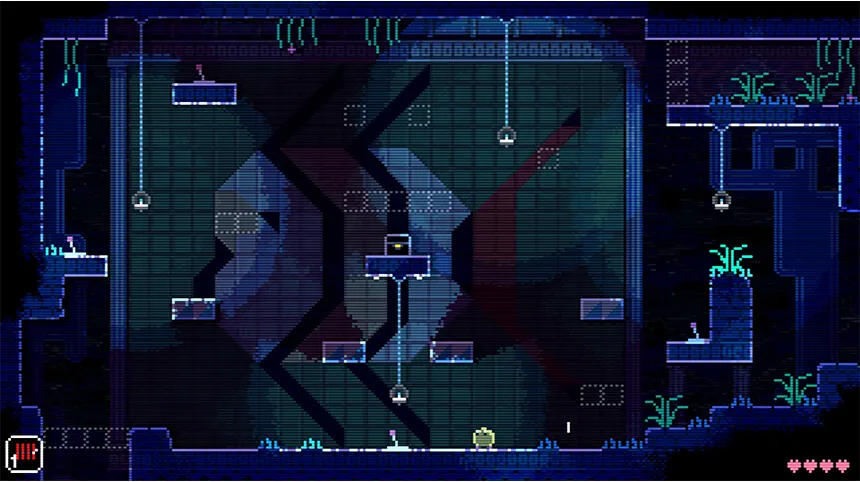 Copyright: ANIMAL WELL© 2024 Shared Memory LLC.[/caption]
- Atmospherical World: The gorgeously handcrafted pixel artwork creates this enchanting, immersive atmosphere that drags players into its mystic realm.
- Engaging Story: Although the story is very subtle and told more through the environment and interaction by the player character, it's there to add a little lore and intrigue to the game.
- Sound Design: The enchanting soundtrack with immersive sound effects enhances the overall atmosphere, making exploration and puzzle-solving more engaging.
- Replayability: Animal Well is full of secrets, and the many ways to go about puzzles give this game high replayability, so players revisit the game for all its secrets to be revealed.
- Minimalist UI: There is a clean, minimalistic user interface that keeps players right within the world without extra distractions.
- Challenging Yet Accessible: The puzzles are made to be challenging yet reasonable for seasoned puzzle players and those who are new to the genre.
Technical Specifications: System Requirements
Minimum System Requirements
- Operating System: Windows 10 (64-bit)
- Processor: Intel Pentium 1.0 GHz or equivalent
- Memory: 1 GB RAM
- Graphics: Integrated Graphics (Intel HD or better)
- DirectX: Version 12
- Storage: 40 MB available space
Recommended System Requirements
- Operating System: Windows 10 (64-bit)
- Processor: Intel Core i5 or equivalent
- Memory: 2 GB RAM
- Graphics: Dedicated GPU (GeForce GTX 1050 or better)
- DirectX: Version 12
- Storage: 50 MB available space
Conclusion
Animal Well is an immersive puzzle adventure game with challenging puzzles, secret areas, and stunningly handcrafted worlds. With its innovative gameplay mechanics and nonlinear exploration-based design, the title is bound to be an endearing and fascinating experience for players. Animal Well runs on PC, PlayStation 5, Nintendo Switch, and Xbox Series X|S, offering a smooth experience with low system requirements. Whether you're a veteran puzzle solver or a newcomer, this game is going to be an unforgettable journey of mystery and discovery. Stay ahead in the gaming world! Explore all the latest updates, news, and trends in the gaming industry with ARPay Gaming News – your ultimate hub for everything gaming!FAQs
How difficult is Animal Well?
This isn't a difficult game, chiefly because it relies more on close observation and problem-solving than it does on reflex-oriented combat. Still, there are some things worth knowing that aren't very obvious in the opening hours of Animal Well.Has everything in Animal Well been found?
Your main goal, at least initially, seems to be to collect a whole bunch of eggs for a giant peacock. But that's never explained outright. Almost nothing in Animal Well is explained. You're simply dropped into this world and left to figure things out.What's the point of Animal Well?
There is more than what you see. How long is Animal Well? When focusing on the main objectives, Animal Well is about 6½ Hours in length. If you're a gamer who strives to see all aspects of the game, you are likely to spend around 17 Hours to obtain 100% completion.Animal Well: What “Unravel the Secrets” Really Implies
The title “Animal Well: Unravel the Secrets of this Puzzle Adventure” sets a clear expectation: this is not only a game you finish, but a world you decode. In puzzle-adventure design, “secrets” usually means layered discovery, environmental clues, and solutions that reward attention rather than brute force. Since the current body is empty, this explainer stays grounded in those safe, title-supported themes and avoids unverified specifics like exact areas, item names, story beats, or hidden sequence details.
A useful guide for this kind of game should not hand out spoilers by default. It should teach a way of thinking: how to observe, test, connect clues, and keep momentum when stuck. If you approach Animal Well with the right mindset, the game becomes less about random trial and error and more about meaningful pattern recognition.
Why Puzzle Adventures Feel So Addictive
Puzzle adventures are compelling because they replace constant combat pressure with cognitive tension. You are not only asking “Can I react fast enough?” but “What am I missing?” That question drives curiosity. Every solved mystery proves that the world is readable, and every unsolved one suggests that a larger logic exists just beyond your current understanding.
Games built around secrets also create long-tail satisfaction. Early details that look decorative often gain meaning later. A strange symbol, a quiet corner, or a route you could not use at first may become central much later. This delayed payoff is one of the strongest reasons players remember puzzle adventures long after completion.
Core Mindset: Observe Before You Act
Many players lose time because they act too quickly. In secret-heavy games, speed is usually less important than clarity. Before interacting, pause and scan. Look for repetition, contrast, geometry, movement behavior, and suspiciously placed structures. The world often communicates in visual language before it ever confirms anything directly.
- Scan the whole room first, then test one idea at a time.
- Treat unusual patterns as intentional, not accidental.
- If a space feels too empty or too symmetrical, investigate it.
This simple discipline prevents noise. Instead of trying everything, you begin building hypotheses. That shift is the difference between confusion and progress.
How to Read Environmental Clues
Environmental storytelling in puzzle adventures usually serves two jobs: atmosphere and instruction. A good secret is rarely pure luck; the game often gives subtle direction through arrangement, spacing, and contrast. Your task is to read that direction without forcing conclusions too early.
- Identify what is normal in an area.
- Spot what breaks that normal pattern.
- Test one controlled interaction.
- Re-evaluate based on what changed.
If nothing changes, the attempt still gives useful data. Failure in this genre is often information, not wasted time.
Progress Strategy: Build a Clue Map, Not Just a Route
In linear games, route memory is enough. In secret-rich puzzle adventures, you need clue memory. Keep lightweight notes: locked paths, suspicious symbols, unreachable spaces, interaction points that lacked context, and places that felt important but unresolved. These notes turn backtracking from frustration into targeted exploration.
- Tag unresolved doors or blocked transitions.
- Mark “maybe important” visual motifs.
- Track puzzles that changed state but did not fully resolve.
- Record where you suspected a hidden mechanic but lacked proof.
This system saves huge time later. When new understanding arrives, you immediately know where to revisit.
The Right Way to Handle Getting Stuck
Getting stuck is expected in puzzle adventures, especially games framed around secrets. The mistake is staying stuck in the same room with the same idea for too long. Productive players rotate context: they switch area, test old clues with new perspective, or temporarily prioritize a different objective.
- Set a soft time limit for one puzzle attempt.
- If no progress, switch to another unresolved thread.
- Return later with fresh eyes and updated assumptions.
This prevents burnout and often creates breakthrough moments. Many hard puzzles are solved indirectly, after learning something elsewhere.
Pacing Your Play Sessions for Better Discovery
Secret-focused games can tempt long sessions, but puzzle quality drops when attention drops. If your pattern reading weakens, your attempts become random and your confidence falls. Short, high-focus sessions usually outperform marathon sessions for this genre.
- Use focused 45–90 minute sessions when possible.
- End each session by writing one next-step objective.
- Take breaks after repeated failed hypotheses.
Stopping at a clear checkpoint preserves momentum and makes re-entry easier.
Exploration vs Completion: Avoid the 100% Trap Too Early
Completion goals are rewarding, but forcing total completion too early can flatten the sense of wonder. In games about unraveling secrets, discovery should lead completion, not the other way around. First understand the world’s language; then optimize coverage. If you reverse that order, the game may feel like a checklist instead of an adventure.
A practical rule: during early and mid progress, prioritize meaningful unresolved mysteries over exhaustive cleanup. Save tight completion passes for later, when your toolkit of understanding is stronger.
Comparison Point: Puzzle Adventure vs Pure Logic Game
Pure logic games often isolate puzzles from world context. Puzzle adventures embed puzzles inside space, mood, and exploration loops. That difference changes how you should think. In a pure logic game, the puzzle itself is the full problem. In a puzzle adventure, the problem may include where you are, what you have already seen, and what the world is trying to teach you.
Animal Well, by title framing, sits in the second category: an adventure where secrets are part of world reading. So evaluate progress not only by solved rooms, but by increased understanding of the game’s internal language.
Common Mistakes New Players Make
- Rushing interactions before observing full room context.
- Trying every action randomly instead of testing hypotheses.
- Ignoring minor visual anomalies that later become key clues.
- Staying on one puzzle too long without context switching.
- Forgetting unresolved clues and repeating old dead ends.
Avoiding these mistakes dramatically improves both pace and enjoyment.
Practical 5-Step Daily Routine for Steady Progress
- Warm-up pass: revisit one previously confusing area for 5–10 minutes.
- Primary objective: pick one mystery thread and pursue it.
- Context switch: if stalled, move to a secondary clue line.
- Documentation: note newly opened questions and confirmed non-solutions.
- Session close: set a clear first action for next session.
This routine keeps momentum consistent and reduces reorientation time each day.
Summary Box
- Treat Animal Well as a world to decode, not a checklist to clear.
- Observation-first play is the fastest path to meaningful progress.
- Use a clue map to convert backtracking into targeted discovery.
- Context switching solves more puzzles than brute-force repetition.
- Short, structured sessions preserve both clarity and enjoyment.