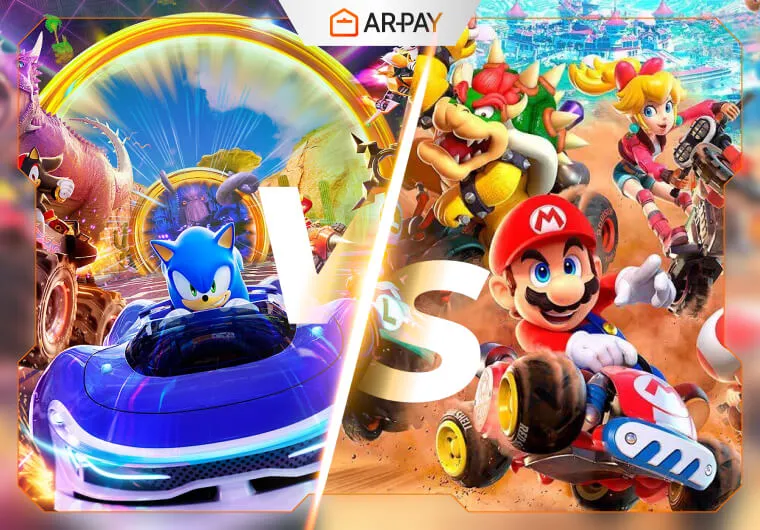
Kart racing comparisons usually collapse into brand loyalty too quickly. One side talks about Mario Kart as the untouchable standard for party racing. The other side argues that Sonic’s newer racers are the ones willing to take real risks. In 2026, that split still feels useful, but only if you move past mascot recognition and look at what each game is actually trying to do.
Mario Kart World is much easier to ground because Nintendo’s current official store page confirms several major features: it is a Nintendo Switch 2 exclusive, it supports races with up to 24 drivers, and it builds its structure around interconnected courses, changing weather, and a day/night cycle. Sonic Racing CrossWorlds is harder to verify cleanly from the sources available during this refresh, so some of the original article’s more detailed claims about its gadgets, portals, crossplay, and team systems should be treated carefully until matched against a direct official source.
Gameplay feel: refinement versus disruption
The cleanest way to frame the matchup is this: Mario Kart World appears to refine a familiar style at a larger scale, while Sonic Racing CrossWorlds is presented as a more disruptive alternative. Mario Kart has always won people over through readability. You understand the drift, the item logic, and the rhythm of a race quickly, even if mastering the pack dynamics takes much longer. That instant legibility is a huge part of why the series survives every generation shift.
Mario Kart World seems to preserve that strength while pushing scope outward. Nintendo’s official description emphasizes interconnected paths, four connected courses in Grand Prix, and techniques like rail riding, wall jumping, and skimming across water. That suggests a game still rooted in traditional Mario Kart readability, but with more movement expression and larger-feeling course design than earlier entries.
Sonic Racing CrossWorlds, by contrast, is described in the original article as a racer that leans harder into planning, adaptation, and surprise. The problem is that many of the specifics behind that description could not be safely re-verified here. Claims about gadget loadouts, portal-driven track shifts, and deeper competitive layers may be true, but they still need source confirmation before they should be treated as settled. Even so, the broader contrast is still believable: Sonic is being framed as the more experimental choice, while Mario remains the more immediately welcoming one.
Track design: a connected world versus volatile spectacle
This is where Mario Kart World has the strongest verified edge in the comparison. Nintendo is clearly positioning the game around a world-spanning structure rather than isolated menu-selected tracks alone. The official page explicitly says the world is your racetrack, highlights connected environments like mountains, forests, and cities, and points to shifting weather and a day/night cycle as meaningful pieces of the experience. That is a substantial evolution for Mario Kart, even if it does not abandon the series’ core logic.
That matters because Mario Kart’s older magic came from memorable tracks; Mario Kart World seems to be chasing memorable continuity. The appeal is not just one iconic circuit, but the sense of motion between places. If it works, it could make the series feel bigger without making it less readable.
Sonic Racing CrossWorlds is portrayed in the source article as the more volatile track-design game, one built around dimensional shifts and mid-race transitions that force adaptation. That is an exciting comparison point because it suggests two different ideas of freshness. Mario refreshes by connecting a world. Sonic refreshes by destabilizing it. But again, the Sonic side of that claim needs a more reliable official source before it can be treated as firm editorial fact.
Roster and tone: comfort food versus fan-service depth
Mario Kart’s strength has never been surprise alone. It is comfort, clarity, and broad recognition. People know the characters, understand the tone, and can usually guess how the game wants to be played before the first race is over. Mario Kart World appears to extend that formula with new drivers, vehicles, outfits, and items, but the appeal is still recognizably Mario: bright, readable, playful, and cross-generational.
Sonic racers traditionally compete from a different angle. Their strongest emotional hook is often not universal familiarity but fan depth. A Sonic game can win over longtime players by reaching deeper into its history and celebrating parts of the franchise casual players barely remember. The original article leans on exactly that distinction. It makes sense conceptually, but the exact character-roster claims here should still be checked before publication.
Multiplayer: instant party game or dedicated group game?
If you are buying one of these games mainly for local sessions, Mario Kart World is the safer recommendation. That is not faint praise. It is one of the hardest things in game design to make a racer that works for children, veterans, lapsed players, and guests who barely touch games. Mario Kart has been elite at that for years, and nothing in the verified 2026 material suggests it is moving away from that identity.
Nintendo’s official messaging reinforces that the game wants to be socially central. There is support for 24-driver races, separate multiplayer modes like Balloon Battle and Coin Runners, and GameChat integration for friends racing or roaming together. Some details around access conditions and membership timing are explicitly time-sensitive, including Nintendo’s note that GameChat did not require a Nintendo Switch Online membership until March 31, 2026. After that, membership is required. That kind of service detail matters and should be preserved carefully when discussing online value.
Sonic Racing CrossWorlds is pitched in the source material as the better fit for dedicated groups that want coordination and mechanical novelty. That may well be true. But because the strongest online-feature claims around crossplay, team systems, and matchmaking could not be directly confirmed here, the responsible comparison is to treat Sonic as the likely deeper-but-riskier multiplayer option rather than to state those features as settled fact.
Verdict: which one should you actually choose?
Choose Mario Kart World if you want the most dependable all-ages racer, the clearest official feature set, and the highest confidence that your purchase will work for solo play, family play, and broad social sessions. The verified Nintendo material already makes a strong case that this is the premium polished option in the category.
Choose Sonic Racing CrossWorlds only if the experimental side of the pitch is exactly what attracts you and you are willing to verify the current feature set first. The original article gives it the role of the innovator, and that might be the right read, but too many of its concrete comparison points remain under-sourced in this refresh.
So the safest 2026 conclusion is simple: Mario Kart World is the easier recommendation, not because Sonic cannot compete, but because Mario’s case is clearer, better sourced, and easier to trust right now. Sonic may still be the more interesting gamble. Mario is the more dependable buy.