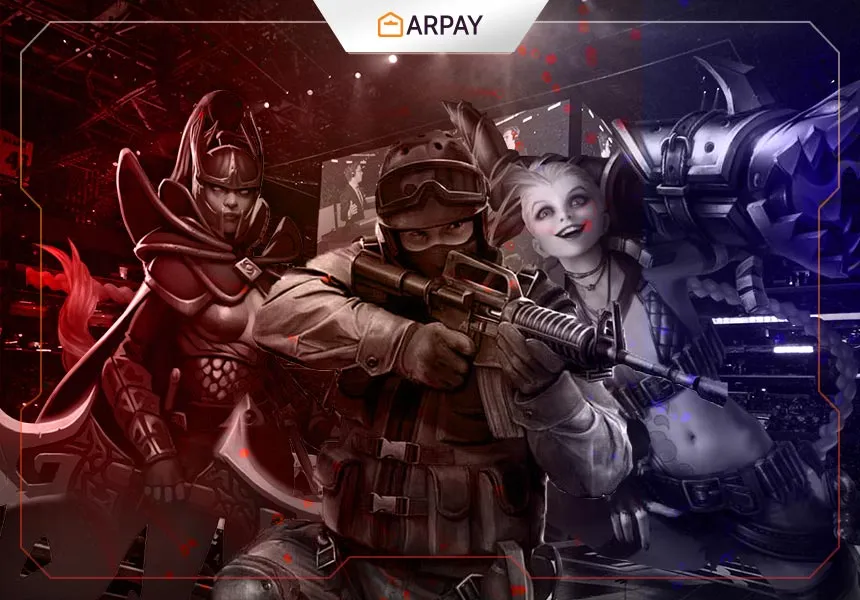
Certainly, competitive games are among the most productive games in the video games market, after becoming a huge field that includes millions of players from all over the world, where many professional players participate in these games, and these games fall under the name of “competitive games” that resulted in the formation Electronic sports ", which attracted many players from all over the world, after the creation of special tournaments and teams in this field.
Through this article, we will present the best and most powerful competitive games, which will make you stay at home during tournament time, as you can enter these strong competitions with other players from all over the world via the Internet, and competition is not only the fun thing in these games but also cooperation One of the most important things that attract players through playing in groups, as well as drawing appropriate plans to win before entering the competition, which will raise your ranking in the global rankings in the game among the players.
And competitive video games, known as "e-sports", have enjoyed a great deal of the gaming industry in the world, which continues to grow amid the increase in the number of viewership of this sport or its entry as players. In addition to the fact that these games now offer competitive stages based on your ranking among the players, through your progress in playing and continuing to win, as well as your level of performance while playing, the desire of players to reach the highest positions has become the main goal of players in the world of competitive games.
The best competitive video games of 2021

First: Counter-Strike: Global Offensive
Counter-Strike: Global Offensive is one of the best competitive shooting games, as the game was first launched in 1999, and since then it has become the most popular first-person shooter until the present day. In 2020, the number of Counter-Strike: Global Offensive players exceeded 1,300,000.
Counter-Strike: Global Offensive follows a concept that is fairly simple, with the gameplay based on two teams of 5 players each, playing against each other, one of these teams attacking, while the other team protects the points that the attacking team seeks to detonate. The first team seeks to eliminate the other team or plant a bomb in one of the places designated for it and detonate it to eliminate it. Meanwhile, the other team seeks either to destroy the attacking team while protecting the points or to dismantle the bomb planted by the attacking team.

Second: Dota 2 game
Dota 2 is one of the most difficult and complex competitive video games, with an average of 550,000 players around the world, as well as winning the largest number of electronic sports awards, with prizes awarded more than $ 30 million in 2019. Therefore, It is one of the most popular esports and the most rewarding game for its players and fans in the world.
It is a strategic game, given that the style of play in it also depends on two teams each consisting of 5 players, but you take longer to learn it at first, and each player has his own hero while playing, and each hero or character has his own abilities that distinguish him from other characters, Which can be improved and upgraded with progress in playing, and the main goal of the game is to destroy the fortress of the other team, after reaching it using a tight strategy, noting that the game certainly provides the property of team play or cooperative play without which you will not be able to achieve victory.
Third: Rainbow Six Siege
Although the beginning of Rainbow Six Siege, taken from Tom Clancy books, was not a strong start, it improved greatly later, until it became one of the most popular competitive games among players around the world, until the average number of its players exceeded 120 thousand players, in addition Over 250,000 viewers of the Six Major Final.
The idea of the game revolves around first-person shooting, and the gameplay in it also depends on the use of tight strategies, by two teams of 5 players each, playing against each other. They compete with each other to defend their own area and attack the other team's area. The game includes many objectives such as planting bombs, releasing prisoners, or controlling a safe area. And the winning team in the end is the team that gets the most points, by achieving the most goals mentioned.

Fourth: League of Legends game
League of Legends is also considered one of the most competitive games around the world and includes more than 115 million players, and the game recorded the largest number of viewers in the world during the past year 2020, due to its registration in the World Championship of more than 100 million viewers.
League of Legends is similar to Dota 2 in terms of the strategy used in gameplay, as it combines players' strategy with understanding the game by playing the roles of characters available in the game, and players compete in the game in the same way as Dota 2, by confronting head-on on the battlefield. Also, each player has the ability to choose the character of the hero he wants to play with, and also each character in the game has abilities and characteristics that distinguish each character from the others, which can be promoted through progress in playing. And the winning team in the end is the team that completed the goal of controlling the base of the other team.
Fifth: Overwatch game
Since Overwatch was first launched in 2016, it has become one of the most important and best competitive games, and the style of play in Overwatch relies on two teams consisting of 6 players each, competing with each other to control the other team and eliminate it. The game is considered from the category of shooting games, which is characterized by a style of play full of action and movement, and depends on the style of cooperative play, and also on the abilities of each of the characters available in the game. In the end, after knowing a list of the best and most powerful competitive games for the current year 2021, which of them would you choose to try to start your battle? You can download and buy any game you want to try by purchasing PlayStation and Xbox cards from ar-pay, which provides you with all kinds of prepaid gift cards online at the best prices in Saudi Arabia.Start the Competition: How to Read the Most Competitive Video Games of 2021
The title “Start the competition: Most competitive video games of 2021” points to one clear goal: helping readers understand what made certain games highly competitive and why players stayed invested in them. Since the current article body is empty, this expansion avoids unsupported claims such as exact rankings, prize-pool numbers, platform exclusivity, patch-specific outcomes, or tournament results. Instead, it offers a practical explainer framework for evaluating competitive games in 2021 and beyond.
A useful competitive-game guide should do more than list names. It should explain what competition actually means in play: skill expression, decision pressure, teamwork, adaptation, and consistency under stress. This article follows that approach so readers can judge games by quality signals, not only popularity.
What Makes a Game Truly Competitive?
A competitive game is not simply a game with winners and losers. Nearly every game has that. Competitive depth appears when better decisions, better execution, and better teamwork lead to reliably better outcomes over time. In other words, the game rewards improvement and punishes autopilot habits.
- Skill ceiling: Advanced players can keep improving instead of hitting a shallow cap.
- Clarity: Players can read why they won or lost.
- Counterplay: No single strategy remains dominant forever.
- Consistency: Performance reflects decisions, not random outcomes alone.
- Community structure: Ranked systems, scrims, and regular competition support long-term growth.
2021 Competitive Landscape: Why It Stood Out
The competitive scene around 2021 was shaped by players seeking stable online ecosystems, frequent updates, and games that could support both casual entry and high-skill mastery. The strongest competitive titles were not always the newest games; many were games with mature systems and active communities. This is an important lesson for readers: competitive relevance is about structure and retention, not release novelty.
In practical terms, players gravitated toward genres that naturally support repeated competition: tactical shooters, battle royale formats, MOBAs, team-based hero games, sports esports titles, and precise fighting games. Each genre rewards different strengths, but all share one trait: improvement is measurable.
Core Competitive Genres and Their Strengths
1) Tactical Team Shooters
These games emphasize communication, map control, utility timing, and composure under pressure. Mechanical aim matters, but pure mechanics rarely win alone. Competitive depth comes from coordinated decisions and disciplined execution.
2) Battle Royale Competition
Battle royale formats combine survival decisions, positioning, resource management, and late-game discipline. Strong players manage risk early and convert opportunities efficiently in final circles. Adaptation is essential because no two matches unfold the same way.
3) MOBA-Style Team Strategy
MOBAs reward macro decision-making, objective timing, role clarity, and scaling knowledge. They are highly competitive because every minute has tradeoffs: pressure, farm, rotations, and team-fight setup. Mistakes are often strategic before they are mechanical.
4) Fighting Games
Fighting games are direct tests of timing, spacing, matchup knowledge, and mental discipline. Competitive value is high because there is little room to hide behind teammates. Improvement is deeply personal and highly visible.
5) Sports and Simulation Competition
Sports titles can be extremely competitive when they balance player control, tactical planning, and consistent online infrastructure. These games often attract players who enjoy structured seasons, leaderboard pressure, and strategic adaptation between matches.
How to Choose the Right Competitive Game for You
The “best” competitive game is the one that matches your strengths and motivation style. Some players enjoy strict teamwork and voice coordination. Others prefer one-versus-one accountability. Some thrive in long strategic matches; others prefer short, intense rounds. Choosing correctly reduces burnout and accelerates improvement.
- Decide if you prefer team responsibility or solo responsibility.
- Pick a match length that fits your schedule and focus capacity.
- Choose a game with clear feedback loops so you can learn from losses.
- Check whether the community has healthy ranked progression and active competition.
- Prefer games where improvement feels motivating, not purely stressful.
Practical Improvement Plan for Competitive Players
Most players plateau because they play many matches without structured review. If you want to climb, treat each session as training, not only entertainment. You do not need complicated analytics; you need a repeatable method.
- Set one focus per session (aim discipline, positioning, economy, rotations, or communication).
- After each match, record one mistake and one strong decision.
- Review losses for patterns instead of blaming one event.
- Practice under pressure, not only in low-risk modes.
- Track weekly progress, not match-to-match emotional swings.
Common Mistakes in Competitive Games
Players often assume more playtime automatically means better results. In reality, low-quality repetition builds bad habits. Competitive progress depends on focused repetition and feedback.
- Playing tilted and continuing after obvious mental fatigue.
- Changing settings and strategies too frequently.
- Copying high-level tactics without understanding fundamentals.
- Ignoring communication quality in team-based modes.
- Treating ranked points as the only measure of growth.
Comparison: Casual Fun vs Competitive Commitment
Casual play and competitive play are both valid, but they require different expectations. Casual sessions prioritize variety and immediate enjoyment. Competitive sessions prioritize consistency, discipline, and long-term skill growth. Problems appear when players expect casual effort to produce competitive results. The healthiest approach is to consciously choose your mode for each session: training mode or relax mode.
This comparison matters for 2021-style competitive titles because many players entered ranked ecosystems from casual backgrounds. The transition succeeds when players shift from reactive play to intentional play.
Related Context: Why Competitive Communities Last
Games remain competitive when communities can support improvement across skill levels. New players need onboarding and understandable rankings. Mid-level players need clear goals and meaningful progression. High-level players need deep systems and active match quality. If one layer fails, retention weakens.
That is why the strongest competitive games are usually those that combine design quality with social infrastructure: guides, tournaments, content creators, and active team culture. The game is the engine, but the community is the ecosystem.
FAQ
Do I need high mechanical skill to enjoy competitive games?
Not necessarily. Many competitive games reward decision-making, communication, and consistency as much as raw mechanics. Mechanical skill helps, but it is not the only path to improvement.
How many games should I play per day to improve?
Quality matters more than volume. Focused sessions with review usually improve performance faster than long unfocused grinds.
Should I switch games if I stop climbing?
First check your process. If you are repeating the same mistakes, changing games may only reset your rank, not your habits. Improve your method before changing titles.
What is the best way to handle ranked frustration?
Use short breaks, session goals, and post-match notes. Emotional control is part of competitive skill, not separate from it.
Summary Box
- Competitive games are defined by skill expression, clarity, and counterplay.
- 2021 highlighted the strength of established competitive ecosystems.
- Choose a game based on your learning style, not hype alone.
- Structured review beats raw match volume for long-term improvement.
- Sustainable competitive growth comes from discipline, adaptation, and community support.